
Tire Changes in Puerto Rico: What to Do If You Have a Flat or Damaged Tire

Having a flat or damaged tire while driving can become an unexpected and frustrating situation. Whether caused by a nail, wear, loss of pressure, or an impact with a pothole, knowing how to respond can help you avoid additional damage to your vehicle and reduce unnecessary risks.
In Puerto Rico, traffic conditions, highways, and some narrow roads can make changing a tire difficult, especially at night or when it rains.
Therefore, before attempting to change it yourself, it is important to evaluate whether the location is safe and whether you have the appropriate tools.
At Road Assist, we coordinate tire change services on the road and at home, subject to location, safety conditions, and provider availability.

1. How Do You Know If You Need to Change a Tire?
There are different signs that may indicate that a tire is losing pressure or has damage.
Sudden Loss of Pressure
If the vehicle begins to lean to one side, the steering feels different, or the tire pressure warning light comes on, you may have an air leak.
Visible Wear or Cracks
Tires with excessive wear, cuts, deformations, or cracks can pose a risk while driving.
Vibrations While Driving
An unexpected vibration may be related to tire problems, although it can also have other mechanical causes.
Impacts With Potholes or Curbs
A strong impact can cause internal damage, wheel rim deformation, or pressure loss that is not always immediately visible.
Important: Do not continue driving on a completely flat tire. This can damage the rim, affect vehicle control, and make the problem worse.
2. What Should You Do Immediately If a Tire Goes Flat While Driving?
The first thing is to maintain control of the vehicle.
Avoid braking suddenly or making abrupt steering movements.
Gradually reduce your speed and, if conditions allow, look for a safe place to stop.
Once parked:
Turn on your hazard lights.
Place the transmission in park or the appropriate position.
Apply the parking brake.
Evaluate traffic conditions.
Avoid getting out of the vehicle if doing so exposes you to a dangerous situation.
Request assistance if you cannot change the tire safely.
If the vehicle is stopped in a location where there is an immediate risk of an accident, contact 911.
3. Basic Steps to Change a Tire If You Decide to Do It Yourself
Changing a tire may seem like a simple task, but it requires following the vehicle manufacturer's instructions and having a safe location.
Never attempt to change a tire in an active traffic lane, on a dangerous curve, on unstable ground, or in a location where you are exposed to traffic.
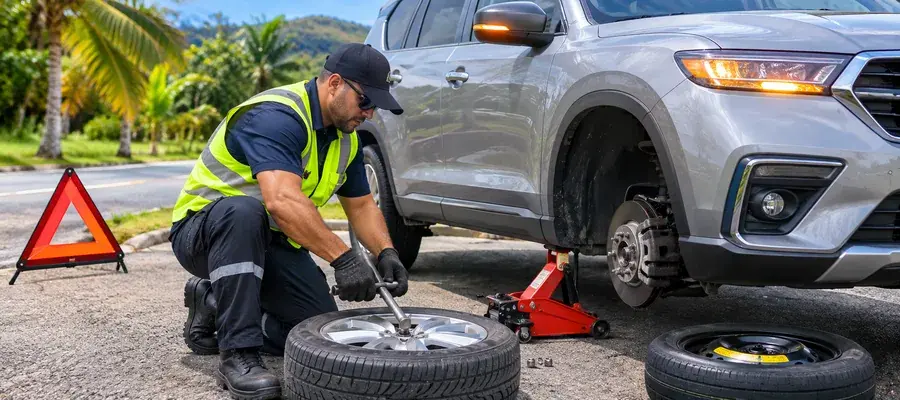
Step 1. Find a Safe and Level Location
Stop the vehicle on a firm surface that is as level as possible, away from traffic.
Step 2. Turn On Your Hazard Lights
They help warn other drivers that your vehicle is stopped.
Step 3. Use Warning Devices When Appropriate
If you have a warning triangle and can place it without exposing yourself to traffic, follow the applicable instructions and regulations. Do not walk through active traffic lanes or put yourself at risk to place it.
Step 4. Prepare the Tools
Verify that you have the spare tire, lug wrench, and appropriate jack for your vehicle.
Step 5. Slightly Loosen the Lug Nuts
With the vehicle still resting on the ground, loosen the lug nuts according to the manufacturer's instructions without removing them completely.
Step 6. Raise the Vehicle
Place the jack only at the lifting point indicated by the manufacturer.
Never place any part of your body underneath a vehicle supported only by a jack.
Step 7. Remove the Damaged Tire
Remove the lug nuts and carefully take off the tire.
Step 8. Install the Spare Tire
Install the spare tire compatible with the vehicle and initially tighten the lug nuts following the sequence recommended by the manufacturer.
Step 9. Lower the Vehicle
Carefully lower the vehicle until it rests on the ground.
Step 10. Tighten the Lug Nuts Correctly
Use the tightening pattern and torque specified by the manufacturer. When appropriate, use a torque wrench.
Before continuing, make sure the spare tire has the appropriate pressure and respect its speed and distance limitations.
4. When Should You Call Roadside Assistance?
Not all situations allow a tire change to be performed safely.
It is advisable to request professional assistance when:
The vehicle is stopped on a highway or in a dangerous area.
It is nighttime and the location has poor lighting.
You do not have the necessary tools.
The jack is damaged or incompatible with the vehicle.
The spare tire is flat, damaged, or unsuitable.
The ground is sloped or unstable.
The lug nuts are too tight or damaged.
You have no experience performing the procedure.
Weather conditions make it difficult to work safely.
Your safety must come before attempting to resolve the situation on your own.
5. What Happens If You Do Not Have a Spare Tire?
Some modern vehicles include a repair kit or an alternative system instead of a spare tire.
However, these systems have limitations and do not work for all types of damage.
For example, a tire with significant sidewall damage may need replacement and may not be suitable for a temporary repair.
If you do not have a usable spare tire, report this situation when requesting assistance so the appropriate service can be evaluated.
Under certain circumstances, it may be necessary to coordinate towing.
6. 24/7 Tire Change Service in Puerto Rico
At Road Assist, we coordinate tire change services on the road and at home, 24 hours a day, seven days a week.
Through our network of providers, we handle requests from drivers who need help with a flat or damaged tire.
When contacting us, it is advisable to provide:
Your location or a nearby landmark.
The make and model of your vehicle.
Which tire is affected.
Whether you have a spare tire in good condition.
Whether the vehicle is on a highway, in a parking lot, or on a secondary road.
Whether there are risky conditions for performing the work.
This information facilitates coordination and allows the necessary equipment and type of assistance to be evaluated.
Service availability and performance are subject to location, safety conditions, and available providers.
7. How Can You Prevent Tire Problems?
Although some situations are unavoidable, preventive maintenance can reduce the likelihood of experiencing difficulties on the road.
The main recommendations include:
Regularly checking tire pressure, preferably when the tires are cold.
Inspecting tires for uneven wear, cuts, or deformations.
Maintaining vehicle maintenance and alignment when appropriate.
Avoiding driving over potholes or obstacles whenever it is safe to do so.
Checking the condition and pressure of the spare tire.
Verifying that the necessary tools are complete and in good condition.
The condition of the tires directly influences the safety and performance of the vehicle.
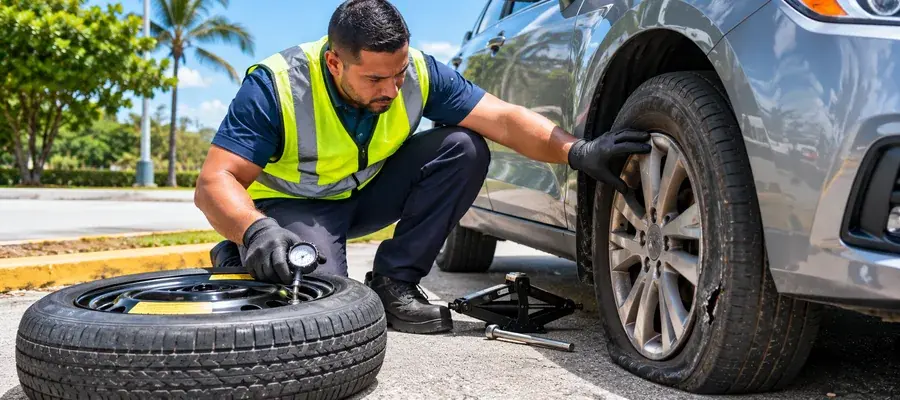
Frequently Asked Questions About Tire Changes in Puerto Rico
Can I Drive With a Flat Tire?
It is not advisable to continue driving with a completely flat tire. You can cause additional damage and compromise vehicle control.
Does Road Assist Offer Tire Changes at Home?
Yes. Road Assist coordinates tire change requests both at home and on the road, depending on service availability.
Can I Request Assistance at Night?
Yes. Road Assist receives assistance requests 24 hours a day, seven days a week.
What Happens If My Vehicle Does Not Have a Spare Tire?
You must report this when requesting assistance. Depending on the vehicle's condition, it may be necessary to coordinate another type of service, such as towing.
Is It Safe to Change a Tire on the Shoulder of a Highway?
Not always. The proximity of traffic can pose a significant risk. If there is no truly safe area to perform the tire change, avoid attempting it and request assistance.
Should I Check the Spare Tire After Installing It?
Yes. Check its pressure and the usage restrictions indicated by the manufacturer, especially if it is a temporary spare tire.
Road Assist: Tire Change Assistance in Puerto Rico
A flat tire does not have to become a more complicated situation.
When you need help, having clear information and requesting the appropriate service can make it easier to get assistance for your vehicle.
At Road Assist, we coordinate tire changes, jump-starts, gasoline delivery, car locksmith services, and towing in Puerto Rico.
Need a Tire Change? Call Now.
Road Assist — Assistance That Accompanies You.
24-Hour Phone: (787) 645-8080
Website: www.asistenciaenlacarretera.com
Disclaimer
Road Assist, LLC is a private consumer services company. This article is for informational purposes and does not replace the vehicle manufacturer's instructions or the recommendations of a qualified professional.
Tire change procedures may vary depending on the model and characteristics of the vehicle. Assistance services are subject to location, safety conditions, and provider availability.
In emergency situations that pose a danger to life or physical safety, call 911 immediately.


Comments